Endless Pages: The Rime of the Ancient Mariner

Samuel Taylor Coleridge - The Rime of the Ancient Mariner (1798)
I have a very profound love and terror of the ocean, the kind that feels reductive to just describe as thalassophobic (or thalassophilic??). Playing Undersea Adventure as a 7 year old kid instilled in me a respect for the natural world, one of fear and fascination. The ocean is treacherous and beautiful, a living goddess, the cradle of life on earth, and its depths not unlike the outer expanse of space. As of 2026, only 28.7%(!) of the global ocean floor has been mapped. That's insane! The big blue remains a source of constant mythologizing and unknowable fear, and I've always been drawn to what I don't understand, the frightening and uncanny, the unreal and inexplicable. So surprise, surprise, when I as a teenager fell in love with the Stygian abysses of human ignorance and unknowable horrors permeating the works of H.P. Lovecraft. This haunting magic is also present everywhere in Coleridge's nautical ghost poem.
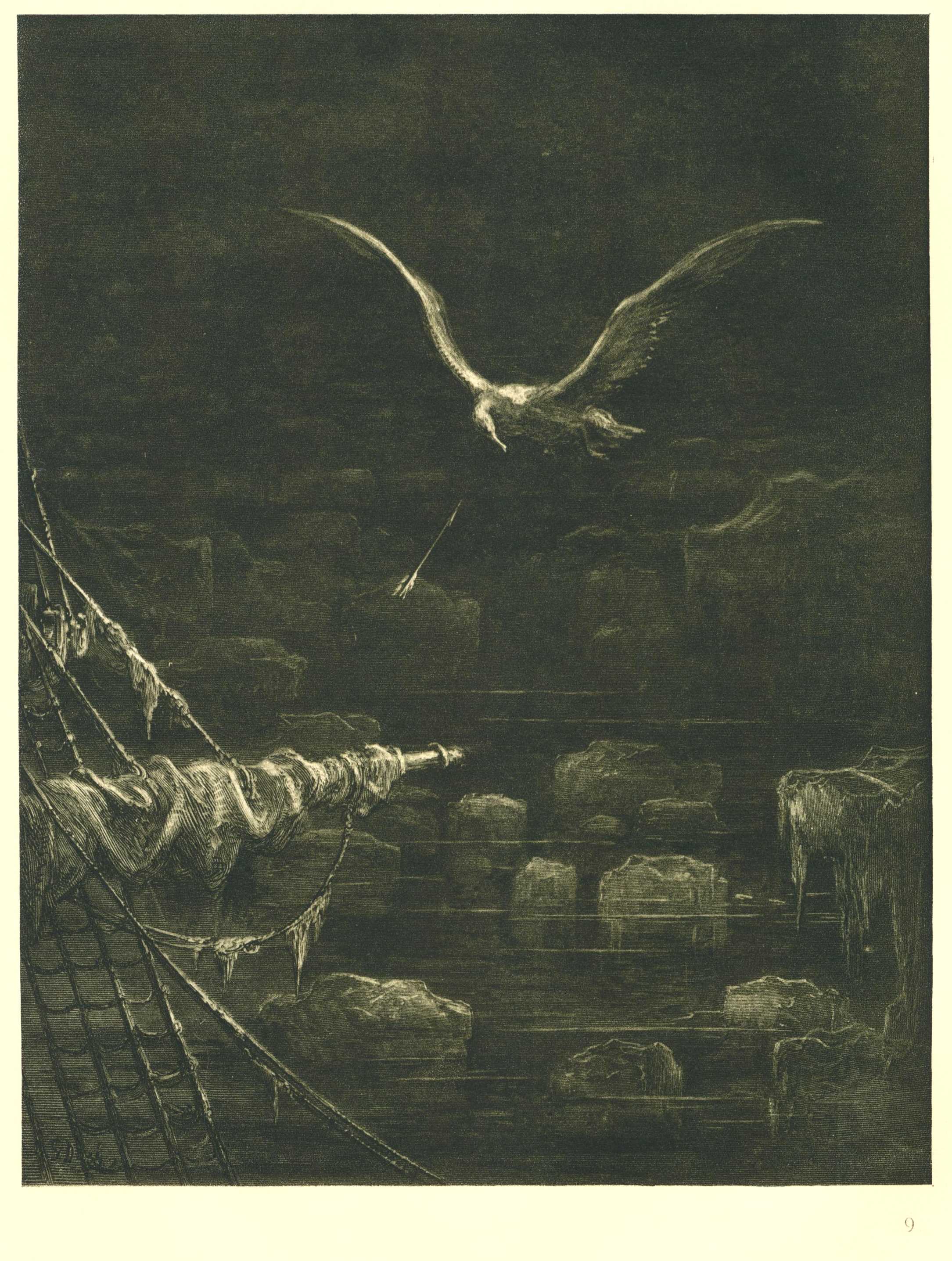
The titular mariner recounts his tale to an unwilling wedding guest, in which he on the Antarctic ocean shoots with his crossbow an albatross leading them into mist and ice. His crew shames him for killing a sign of good luck but change their minds when the weather gets warmer, blaming the cold on the sea bird. The ship then suffers ill fortune and is pursued by icy spirits into becalmed waters, leaving them stranded and without water to drink.


Again, the crew blames their misfortune on the mariner by hanging the dead albatross around his neck, its death weighing a heavy burden on him. As if things weren't dire enough, a ghostly ship appears piloted by a robed skeleton, Death and a morbidly pale woman, the Nightmare Life-in-Death. They proceed to play games of dice for the lives of the crew, with Death winning the entire crew, except for the mariner burdened with guilt, which the pale lady claims. One by one, the crew dies off with horrific faces of disgust, frozen in place to judge the mariner for seven days. The mariner starts appreciating the wondrous sea creatures that he once loathed surrounding his vessel and is inspired by their beauty:
Within the shadow of the ship
I watched their rich attire:
Blue, glossy green, and velvet black,
They coiled and swam; and every track
Was a flash of golden fire.
He enters prayer, causing the albatross to fall from his neck and spirits to possess the bodies of his crew and steers the ship towards his homeland. As the ship nears its shores, it rots and sinks, leaving the mariner to be fished up by a hermit. Now pensive and changed, he is still tormented by his guilt, he wanders and tells the cautionary tale of his wrongdoings.
Always listen to Willem Dafoe...
There's so much to dig into here, but I've tried to introduce the general themes before the text's synopsis, so let's attempt an analysis for comparison.
You have a lot of indicators that really tie in this text with the upcoming rise of Gothic fiction in the 19th century. A ghastly tale of survival at sea and a personification of Death evokes the later Edgar Allan Poe about 50 years prior, which no doubt was one of the very important influences on Poe (and by extension; Lovecraft), with Coleridge being a core figure of British Romanticism that precede Gothic fiction in many ways.
The framing of the protagonist relating his terrible experiences and how he was irreversibly changed, is also a framing that Poe and Lovecraft used to greater extent and effect, combined with the subversion of the "good ending" not being preferable after having been exposed to the horrors of unreality. Having been touched by something that cannot be forgotten.
The killing of the albatross is a violation of the natural world, in this context considered a bringer of good luck and a holy animal of the Christian god, which is very typical for the Romantic period, where nature itself is spiritual and its appreciation worship. I love this about the period, where senseless killings of animals and destruction of the wilderness is seen as something warranting divine retribution and only brings misfortune. Everything is alive, divine, a symbiotic organism inflicting pain upon itself in response.


I read the Dover Publications edition, which includes the wood engravings that french artist Gustave Doré made for the poem in 1875. Doré's works also include engravings for Dante's Divine Comedy, Milton's Paradise Lost, and Poe's The Raven. His style is so grand in scope with incredibly powerful visuals that feel like a fantastical prelude for artwork in mythological fiction to come. Doré's literal engravings for The Rime of the Ancient Mariner apparently also made an incredible impression on a merely six-year-old H.P. Lovecraft1:
[...] imagine a tall, stately Victorian library in a house sometimes visited with my mother or aunts. Marble mantel—thick bearskin rug—endless shelves of books... A house of adults, so that a 6-year-old caller’s interest strays most naturally to the shelves & great centre table & mantel. Fancy then the discovery of a great atlas-sized gift-book leaning against the mantel & having on the cover gilt letters reading “With Illustrations by Gustave Doré”. The title didn’t matter—for didn’t I know the dark, supernal magic of the Doré pictures in our Dante & Milton at home? I open the book—& behold a hellish picture of a corpse-ship with ragged sails under a waning moon! I turn a page... God! A spectral, half-transparent ship on whose deck a corpse & a skeleton play at dice! By this time I am flat on the bearskin rug & ready to thumb through the whole book... of which I’ve never heard before... A sea full of rotting serpents, & death-fires dancing in the black air... troops of angels & daemons... crazed, dying, distorted forms... dead men rising in their putrescence & lifelessly manning the dank rigging of a fatedoomed barque...
Read the poem and see all its wood engravings here:
Gustav Doré - Wood Engravings [Wikimedia Commons]
Samuel Taylor Coleridge - The Rime of the Ancient Mariner [Wikisource]
Joshi, S.T. (2013). I Am Providence: The Life and Times of H.P. Lovecraft. Hippocampus Press.↩